

Receiving the Arabsat 26°E satellite position in Southern Europe requires more than simply turning a dish toward the east. The final result depends on your exact location, the dish installation, signal coverage, dish size and the accuracy of the alignment.
Because Southern Europe covers a wide geographical area, the settings used in one country may not work exactly the same way in another. A dish in Spain, Italy, Malta or Greece can require different pointing angles and LNB adjustments.
The best approach is to follow an organised alignment process rather than moving the dish randomly.
Begin by Identifying Your Location
Before making any adjustments, determine where the satellite dish is installed.
The alignment values for Arabsat can vary between countries and even between different cities.
For the best starting point, you should obtain approximate location-based values for:
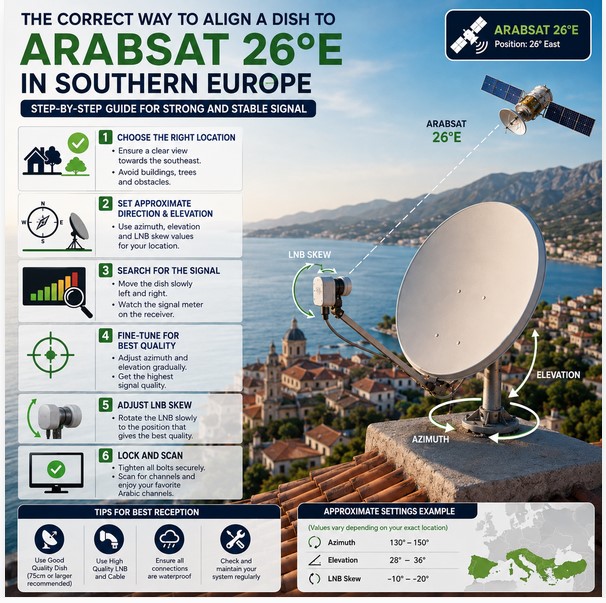
- Azimuth – the horizontal direction of the dish.
- Elevation – how high the dish points above the horizon.
- LNB Skew – the rotation angle of the LNB.
The 26°E orbital position does not mean that the dish should simply be pointed directly east.
It refers to the satellite’s position above the equator, while the direction you see from the ground depends on your geographical location.
Using approximate alignment values for your own city can make the search much faster.
Choose a Clear Location for the Dish
Before installing or adjusting the dish, check the expected signal path.
The dish needs a clear line of sight toward the part of the sky where the satellite appears.
Look for possible obstacles such as:
- Tall buildings.
- Trees.
- Walls.
- Chimneys.
- Roof edges.
- Balconies.
- Nearby hills or elevated ground.
Any object in the signal path can reduce the reception quality or block the signal completely.
A clear installation point gives you a much better chance of achieving a strong and stable signal.
Make Sure the Mounting Pole Is Perfectly Vertical
The dish mounting pole should be strong, stable and perfectly vertical.
Use a spirit level to check the pole before beginning the alignment.
This step is important because the elevation scale on the dish bracket is designed to work correctly when the mounting pole is vertical.
If the pole is leaning, the elevation reading may no longer represent the real dish position.
As a result, finding the satellite can become much more difficult.
Before continuing, check:
- The mounting bracket.
- The strength of the installation.
- The vertical position of the pole.
- All mounting bolts.
Prepare the Receiver Before Searching
Set up the receiver before moving the satellite dish.
Open the satellite installation menu and select the appropriate satellite position.
Then check:
- LNB type.
- LNB frequency settings.
- DiSEqC settings if multiple LNBs are used.
- The correct cable input.
After confirming the settings, open the signal meter.
A signal meter allows you to monitor the changes while the dish is being moved.
If possible, use an appropriate active reference signal for the Arabsat position during the alignment process.
Start from an Approximate Direction
Set the dish to the approximate azimuth and elevation for your location.
This does not need to be perfect at the beginning.
The purpose is to place the dish close to the expected satellite position before starting the detailed search.
Once the dish is near the correct area, begin making smaller movements.
Move the Dish Slowly
One of the most common mistakes is moving the dish too quickly.
Satellite alignment should be performed using slow and controlled movements.
A practical method is:
- Move the dish a very small distance horizontally.
- Stop for a few seconds.
- Check the signal quality.
- Continue slowly.
- Stop making large movements when a signal appears.
Moving too quickly can cause you to pass through the correct satellite position without noticing the signal.
Small movements and patience usually produce better results.
Do Not Rely on Signal Strength Alone
A high Signal Strength reading does not always confirm that you have found the correct satellite.
Your dish may be receiving a signal from another satellite located in a similar area of the sky.
For accurate alignment, pay closer attention to:
- Signal Quality.
- The detected channels or services.
- The satellite selected in the receiver.
- The stability of the reception.
The goal is to confirm that you are receiving the correct satellite position before completing the installation.
Fine-Tune the Dish After Finding the Signal
After receiving the correct Arabsat signal, do not immediately tighten the dish bolts.
Begin the fine-tuning process.
First, adjust the horizontal direction using very small movements.
Watch the signal quality meter.
When the signal reaches its best level, move to the elevation adjustment.
Raise or lower the dish slightly while monitoring the quality.
The strongest signal is often found through extremely small adjustments.
Even a movement of only a few millimetres can affect the final reception quality.
Adjust the LNB Skew
The LNB position is another important part of the alignment process.
After setting the best dish direction and elevation:
- Loosen the LNB holder slightly.
- Rotate the LNB slowly.
- Monitor the signal quality.
- Stop when the quality reaches its best stable level.
- Tighten the holder carefully.
The correct LNB skew can vary depending on your geographical location.
For this reason, the final adjustment should be based on actual signal quality rather than a general visual position.
Why Arabsat Reception Varies Across Southern Europe
There is no single alignment setting that works perfectly across all of Southern Europe.
Reception can be affected by:
- Your geographical location.
- The city where the dish is installed.
- Satellite beam coverage.
- Dish size.
- LNB quality.
- Cable condition.
- Installation accuracy.
- Local obstacles.
- Weather conditions.
A setup that produces excellent reception in one location may require different equipment or more precise alignment in another.
Using location-specific values gives you a much better starting point.
Does Dish Size Matter?
Yes, the size of the satellite dish can affect signal reception.
However, there is no single dish size suitable for every location in Southern Europe.
The required size can depend on:
- Your exact location.
- The satellite beam you want to receive.
- Local reception conditions.
- The required signal margin.
- The quality of the installation.
Before replacing your dish, make sure the current dish has been accurately aligned.
A correctly aligned dish can perform better than a larger dish that has been poorly installed.
However, in areas with weaker reception, a larger dish may provide a better signal margin.
What Should You Do If No Signal Appears?
If you cannot find a signal, avoid continuing with random dish movements.
Instead, inspect the installation.
Check the Satellite Cable
Look for:
- Damaged cable.
- Loose connectors.
- Water entering outdoor connections.
- Poorly fitted plugs.
Check the LNB
Make sure the LNB is:
- Properly connected.
- Correctly installed.
- Securely positioned.
- Compatible with the receiver settings.
Review the Receiver Settings
Confirm:
- The correct satellite selection.
- LNB settings.
- DiSEqC configuration.
- Cable input.
Inspect the Signal Path
Check again for:
- Buildings.
- Trees.
- Walls.
- Other obstacles.
Return to the Approximate Starting Position
Go back to the expected direction and elevation for your location.
Start the search again using slow, controlled movements.
A systematic search is much more effective than moving the dish randomly.
Secure the Dish Carefully
After reaching the strongest stable signal, begin tightening the dish bolts gradually.
Do not tighten all bolts at once.
Check the signal quality after tightening each part.
A small movement caused by tightening a bolt can reduce the signal.
Before finishing, inspect:
- Dish stability.
- Signal quality.
- LNB position.
- Mounting bolts.
- Cable connections.
Tips for Maintaining a Stable Signal
After successfully aligning the dish, regular checks can help maintain stable reception.
Inspect the system for:
- Loose bolts.
- Dish movement caused by wind.
- Damaged cables.
- Water around connectors.
- LNB movement.
- Trees growing into the signal path.
If the signal quality suddenly decreases, check the dish position and connections before making major adjustments.