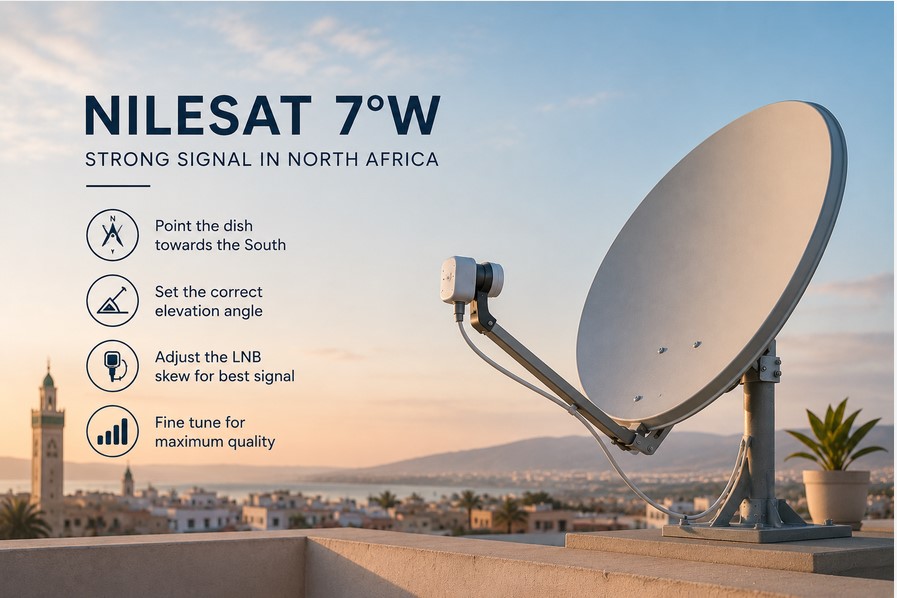


Setting up a satellite dish for Nilesat in North Africa is not simply a matter of moving the dish until a signal appears. The final result depends on several adjustments working together, including the dish location, mounting position, general direction, elevation and LNB alignment.
Nilesat is widely received across several North African countries, but the dish does not point in exactly the same direction everywhere. A setup that works well in one city may require different adjustments in another.
The following practical guide takes you through the complete process, from preparing the dish to securing the strongest possible signal.
Start with the Installation Point, Not the Signal Meter
Many people begin by looking at the receiver’s signal meter and immediately moving the dish. In reality, the installation location should be checked first.
Stand where the dish will be installed and look toward the part of the sky where the satellite is expected to appear. Make sure there are no obstacles in the path.
Common problems include:
- A tree directly in front of the dish.
- A nearby wall.
- A chimney.
- Another building.
- A roof edge.
- A balcony structure.
Satellite signals cannot pass through solid obstacles, so the best starting point is an open location with a clear view.
A location that looks clear during installation should also be considered for the future. For example, a small tree may become a major signal obstruction as it grows.
Check the Pole Before Touching the Dish
The satellite dish can only be adjusted accurately if the mounting pole is installed correctly.
Use a spirit level and check the pole from more than one side. If it is leaning, correct the problem before beginning the alignment process.
This step may seem simple, but it can save a lot of time.
A tilted pole can cause problems with:
- The elevation setting.
- The dish bracket.
- The accuracy of the alignment.
- The final signal quality.
Once the pole is secure and vertical, the rest of the alignment becomes much easier.
Where Should the Nilesat Dish Point?
Nilesat is associated with the 7° West orbital position, but this does not mean that a dish in North Africa should simply be pointed toward the west.
The visible position of a satellite depends on where the viewer is located.
A dish installed in Egypt will require a different pointing direction from a dish installed in Tunisia, Algeria or Morocco.
This is why the best approach is to find the approximate satellite position for your own location before making any major dish adjustments.
The three main values to consider are:
- Azimuth – the horizontal direction.
- Elevation – how high the dish points.
- LNB Skew – the rotation of the LNB.
These values change depending on the country and city.
Use the Receiver as Your Final Guide
Before starting the physical alignment, open the satellite signal menu on the receiver.
Select the correct satellite position and make sure the LNB settings match the equipment being used.
If you have more than one satellite connected to the same receiver, check the DiSEqC settings carefully.
Then choose a reliable active signal or transponder appropriate for the satellite you are trying to receive.
The receiver should now display the signal meter while you adjust the dish.
Find the Signal Using Small Movements
The easiest way to lose the satellite is to move the dish too quickly.
Start from the approximate direction for your location and move the dish in very small steps.
After each movement:
- Stop.
- Wait for the receiver to update.
- Check the signal quality.
- Continue if necessary.
Do not sweep the dish rapidly from one side to the other.
A satellite signal may only appear when the dish passes through a very narrow area. Slow and controlled movements give you a much better chance of finding it.
Do Not Stop at the First Signal
This is one of the most important parts of the installation.
A signal appearing on the receiver does not always mean that you have found the correct satellite.
There may be other satellite positions in the same general area of the sky.
Once the receiver shows a signal:
- Check the signal quality.
- Confirm the selected satellite.
- Perform a scan if necessary.
- Verify the channels or services found.
The dish should only be considered correctly aligned after the satellite position has been confirmed.
The Secret to a Better Signal Is Fine-Tuning
After finding the correct Nilesat signal, do not immediately tighten the dish bolts.
Instead, begin the fine-tuning stage.
Make tiny adjustments in the horizontal direction and watch what happens to the signal quality.
When you find the best horizontal position, repeat the process with the elevation.
Then make small adjustments to the LNB.
The final few millimetres of movement can sometimes make the difference between an average signal and a strong, stable signal.
How to Adjust the LNB Properly
The LNB is not only responsible for receiving the satellite signal. Its position and rotation can also affect signal quality.
After the dish direction and elevation are close to their best settings, gently rotate the LNB.
Make small movements and monitor the receiver.
Stop when the signal quality reaches its best stable level.
The correct LNB rotation depends on the installation location, so avoid relying only on a general visual position.
The signal meter should be used to confirm the final adjustment.
Secure the Dish Without Losing the Signal
A common mistake is finding an excellent signal and then losing part of it while tightening the bolts.
Tighten the dish gradually and check the signal during the process.
If the signal drops after tightening a bolt, slightly loosen the adjustment and return the dish to its best position.
Check:
- The main mounting bolts.
- The elevation bolts.
- The LNB holder.
- The cable connection.
The dish should be firmly secured, especially in areas exposed to strong winds.
Why Nilesat Reception Is Different Across North Africa
Nilesat reception conditions are not identical across North Africa.
The differences can be related to:
- Geographic location.
- Distance from the strongest coverage area.
- Dish size.
- Local obstacles.
- Weather conditions.
- Equipment quality.
For example, a dish size that provides a strong signal in one location may not produce the same result in another.
This is why there is no single dish adjustment that works perfectly across all of North Africa.
The best method is always to start with location-specific alignment values and then use the receiver’s signal quality meter for final fine-tuning.
If the Signal Does Not Appear
Before changing the dish direction repeatedly, inspect the installation.
Check the following:
The cable: Look for damage, loose connectors or signs of water.
The LNB: Make sure it is correctly connected and working.
The receiver settings: Confirm the satellite selection and DiSEqC configuration.
The mounting pole: Check that it is still vertical.
The signal path: Look for trees, buildings or other obstacles.
The dish position: Return to the approximate direction and begin the search again slowly.
Solving the basic problem first is usually faster than making random dish adjustments.
How to Keep the Signal Stable After Installation
Once the dish is correctly aligned, regular checks can help maintain good reception.
Inspect the installation from time to time and check for:
- Loose bolts.
- Damaged cables.
- Water entering connectors.
- LNB movement.
- Tree growth.
- Wind damage.
A small change in the dish position can reduce signal quality, particularly if the dish was originally aligned with only a small signal margin.