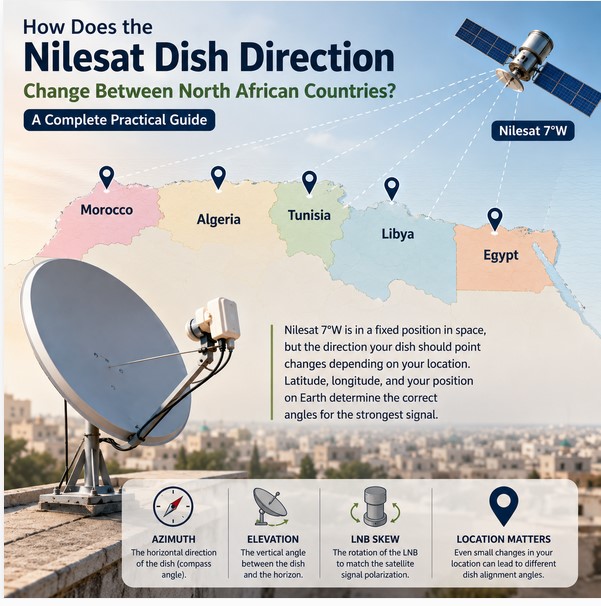
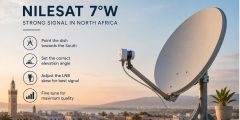

Many satellite TV viewers across North Africa believe Nilesat uses one fixed dish direction for the entire region. They copy settings from a neighbor or another city and expect identical results. In reality the satellite stays at the same orbital position while the required viewing angle changes with the viewer’s location on Earth. A dish aligned correctly in Cairo will not perform the same way if pointed identically in Tunis, Algiers, or Casablanca. This guide explains why the direction shifts and how to adjust for each country.
Understanding Nilesat 7°W
What Does 7°W Mean?
Nilesat occupies the geostationary orbital slot at 7 degrees West. The satellite appears fixed in the sky because it matches Earth’s rotation. It delivers a wide range of free-to-air and encrypted channels to North Africa and the broader Arab region. The fixed position leads many people to assume the dish can point the same way everywhere. The satellite does not move, yet the observer’s position on the curved Earth does.
Why Nilesat Is Popular in North Africa
Nilesat provides reliable coverage across Egypt, Libya, Tunisia, Algeria, and Morocco. Its beam strength and channel package make it the preferred choice for millions of households. Popularity does not eliminate the need for location-specific alignment. Viewers who ignore geographical differences often experience weak signals or missing channels.
Why Does the Nilesat Dish Direction Change?
The Role of Latitude and Longitude
Latitude measures distance north of the equator. Longitude measures distance east or west of the prime meridian. Both values determine the exact line of sight from any point on Earth to the satellite at 7°W. As longitude moves west, the horizontal direction of the dish shifts. As latitude changes, the vertical angle adjusts. These two coordinates create the differences observed across North Africa.
How Geographical Location Affects Dish Alignment
The further a viewer sits from the satellite’s longitude, the greater the change in azimuth. Elevation responds mainly to north-south distance. LNB skew also rotates to match the changing polarization angle. Small shifts between neighboring cities become noticeable when comparing Egypt with Morocco. The satellite remains fixed; only the observer’s position changes.
Nilesat Dish Direction in Egypt
Differences Between Egyptian Regions
In Egypt the dish generally faces south-southwest. Northern coastal cities differ slightly from central and southern locations because of latitude. Eastern areas near the Sinai require minor azimuth adjustments compared with western desert towns. Settings that work in Cairo are not identical in Alexandria, Aswan, or Marsa Matrouh. Even within one country the alignment must match the exact city.
Nilesat Dish Direction in Libya
Moving west into Libya increases the longitude difference. Azimuth continues to shift and elevation changes gradually. Coastal cities such as Tripoli and Benghazi already show clear differences from Egyptian settings. Southern locations further alter elevation. Copying Egyptian angles usually produces weaker signals. Local calculation becomes more important the further west the installation sits.
Nilesat Dish Direction in Tunisia
Tunisia continues the westward progression. Dish orientation moves further from Egyptian reference values. Elevation and LNB skew keep changing. Although Tunisia is narrower east-west than Algeria, the difference from eastern North Africa remains significant. Accurate adjustment matters more here than in locations closer to 7°W.
Nilesat Dish Direction in Algeria
Algeria covers a wide range of longitudes and latitudes. Coastal cities differ from inland and southern towns. Azimuth keeps shifting west, elevation adjusts with latitude, and LNB skew requires corresponding rotation. Settings valid in Algiers are not ideal for Oran or cities further south. Small differences accumulate and reduce signal quality if ignored.
Nilesat Dish Direction in Morocco
Morocco lies furthest west relative to 7°W. The difference from Egyptian alignment is therefore the largest. Azimuth has shifted noticeably, elevation reflects Morocco’s latitude, and LNB skew must be set carefully. Using the same general direction that works in Cairo or Tripoli produces poor results. Local calculation is essential rather than optional.
Understanding Azimuth, Elevation, and LNB Skew
What Is Azimuth?
Azimuth is the horizontal compass direction the dish faces. It tells the installer how far left or right to turn the dish from true south. This value changes most clearly as one travels east or west across North Africa.
What Is Elevation?
Elevation is the vertical angle of the dish above the horizon. It rises or falls mainly according to the viewer’s latitude. Higher latitudes generally require lower elevation angles for Nilesat.
What Is LNB Skew?
LNB skew is the rotation of the low-noise block converter. Correct skew matches the satellite’s signal polarization. Incorrect rotation reduces quality and can eliminate one polarization entirely. Skew changes with both latitude and longitude.
How to Adjust a Nilesat Dish Correctly
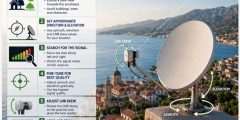
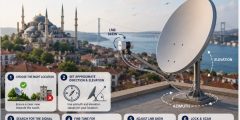
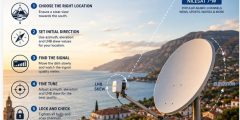
Step 1: Choose the Right Installation Location
Select a spot with a clear southern view. Avoid trees, buildings, water tanks, and any obstacle that can block the line of sight to the satellite.
Step 2: Set the Dish Pole Correctly
Make sure the mounting pole is perfectly vertical. A tilted pole introduces permanent error that no amount of fine-tuning can fully correct.
Step 3: Adjust the Dish Slowly
Set approximate elevation first. Point the dish toward the calculated azimuth. Rotate the LNB to the recommended skew. Move the dish in very small horizontal and vertical increments while watching the receiver.
Step 4: Fine-Tune Signal Quality
Monitor signal quality rather than signal strength alone. Continue small adjustments until quality reaches its highest stable level. Tighten all bolts carefully without shifting the dish.
Common Nilesat Dish Alignment Mistakes
Using one direction for every country is the most frequent error. Copying angles from a different city produces similar problems. Ignoring LNB skew leaves polarization mismatched. Relying on a phone compass without correcting for magnetic declination introduces azimuth error. Moving the dish too quickly makes it easy to pass the correct peak. Obstacles that block the line of sight ruin reception even with perfect angles. Adjusting only by signal strength instead of quality leads to unstable locks. Beginning before the pole is vertical guarantees frustration.
Frequently Asked Questions
Does the Nilesat Dish Direction Change Between Countries?
Yes. Differences in latitude and longitude alter azimuth, elevation, and LNB skew from one North African country to another.
How Can I Find the Exact Nilesat Direction for My Location?
Use a reliable satellite alignment calculator or professional meter. Enter your city name or exact coordinates to receive precise azimuth, elevation, and LNB skew values for Nilesat 7°W.
Is the Nilesat Direction the Same in Egypt and Morocco?
No. The geographical separation produces clearly different alignment requirements.
Why Does the Elevation Angle Change Between Cities?
Elevation depends primarily on the observer’s latitude relative to the satellite.
Does LNB Skew Matter When Receiving Nilesat?
Yes. Incorrect skew reduces signal quality and can eliminate certain polarizations.
Can I Use the Same Dish Settings in Every North African Country?
No. Each location needs its own calculated values.
Why Does My Dish Receive Some Channels but Not Others?
Possible causes include incorrect skew, slight misalignment, or local obstacles affecting one polarization more than the other.
What Should I Check If the Nilesat Signal Is Weak?
Verify clear line of sight, vertical pole, correct elevation and azimuth, proper LNB skew, and cable integrity. Then fine-tune while watching signal quality.