
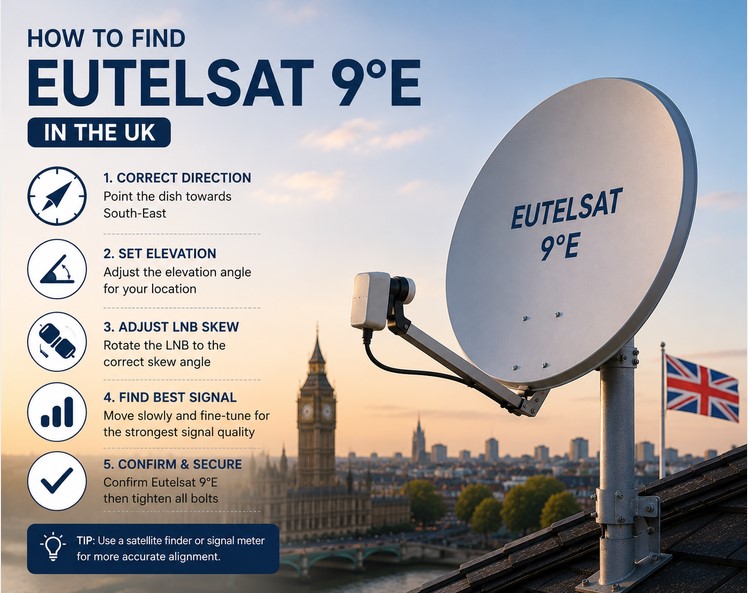


The Eutelsat 9°E satellite position is an important European orbital location used for a range of television, broadcast and data services. Finding this satellite from the United Kingdom requires accurate dish alignment, suitable equipment and careful signal monitoring.
Although Eutelsat 9°E is relatively easy to locate with the correct setup, a small error in dish direction, elevation or LNB position can cause the receiver to lock onto a different satellite. For this reason, it is important to follow a clear alignment method and confirm the correct satellite before completing the installation.
This guide explains how to find and align a satellite dish to Eutelsat 9°E in the UK, including the correct general dish direction, elevation adjustment and signal alignment method.
Choose a Clear Location for the Satellite Dish
Before adjusting the dish, select a location with a clear line of sight toward the satellite.
From the UK, Eutelsat 9°E generally appears toward the south-eastern part of the sky. The exact direction varies according to your location, but the dish needs an unobstructed view in the correct general direction.
Check carefully for:
- Tall buildings.
- Trees and large branches.
- Chimneys.
- Walls.
- Roof structures.
- Nearby properties.
- Other obstacles in the signal path.
A small obstruction can weaken or completely block the satellite signal. Trees should be checked carefully because they can grow over time or move into the signal path during windy weather.
Make Sure the Mounting Pole Is Perfectly Vertical
Before starting the alignment process, make sure the satellite dish mounting pole is completely vertical.
Use a spirit level to check the pole from different sides.
This step is important because the elevation scale on the satellite dish bracket only works correctly when the mounting pole is properly installed.
If the pole is tilted, the elevation angle will not be accurate and finding the satellite can become more difficult.
A stable and vertical mounting pole makes it easier to:
- Set the correct elevation.
- Adjust the dish direction.
- Fine-tune the signal.
- Keep the dish stable during bad weather.
Understand the Correct Direction of Eutelsat 9°E
Although the satellite is located at 9° East, a dish in the UK should not simply point directly east.
From most parts of the United Kingdom, Eutelsat 9°E is generally located toward the south-east.
The exact azimuth changes depending on your location.
For example, the required direction will be different in:
- London.
- Birmingham.
- Manchester.
- Liverpool.
- Cardiff.
- Glasgow.
- Edinburgh.
- Belfast.
For the most accurate result, use a satellite alignment calculator or satellite finder application based on your exact installation location.
This can provide a more precise starting point for the dish direction and elevation.
Set the Approximate Elevation Angle
The elevation angle determines how high the satellite dish points above the horizon.
The correct elevation for Eutelsat 9°E varies across the UK.
In general, viewers farther north may need to point the dish lower than viewers in southern parts of Britain.
To adjust the elevation:
- Loosen the elevation adjustment bolts slightly.
- Set the approximate elevation for your location.
- Use the elevation scale on the dish bracket as a starting point.
- Move the dish slowly upward or downward.
- Monitor the signal quality reading.
Make very small movements.
A small adjustment can make a significant difference when searching for a satellite signal.
Check the Receiver Settings
Before beginning the signal search, check that the receiver is configured correctly.
Typical settings may include:
- Satellite: Eutelsat 9°E
- LNB Type: Universal
- LNB Frequency: According to the installed LNB
- DiSEqC: Configured correctly if multiple LNBs are being used
If your installation includes more than one LNB, make sure Eutelsat 9°E is assigned to the correct DiSEqC port.
Incorrect receiver settings can prevent the receiver from detecting the correct signal.
Search for the Satellite Signal Slowly
Once the approximate direction and elevation have been set, begin searching for Eutelsat 9°E.
Move the dish very slowly from left to right.
Use the following method:
- Move the dish a very small distance.
- Stop and wait for the receiver to update.
- Check the signal quality.
- Continue moving slowly.
- Stop when a signal appears.
Do not move the dish quickly.
Satellite receivers can take a few seconds to update the signal meter. Moving too fast can cause you to pass the correct satellite position.
When a signal appears, begin making even smaller adjustments.
Focus on Signal Quality
Most satellite receivers show two important readings:
- Signal Strength
- Signal Quality
Signal strength alone does not always confirm that the correct satellite has been found.
A nearby satellite can produce a strong signal reading.
For this reason, the most important reading during alignment is usually Signal Quality.
Once the signal appears, adjust the dish slowly until you achieve the highest stable signal quality possible.
The best position is not necessarily the first position where a signal appears. Fine-tuning is important for strong and reliable reception.
Adjust the LNB Skew
The LNB skew is the rotation angle of the LNB.
The correct LNB skew depends on your location in the UK.
After finding Eutelsat 9°E:
- Loosen the LNB holder slightly.
- Rotate the LNB very slowly.
- Watch the signal quality.
- Continue making small adjustments.
- Stop when the best quality is reached.
- Tighten the LNB securely.
A correctly adjusted LNB can improve the stability of the satellite signal.
Confirm That You Have Found Eutelsat 9°E
Do not assume that any strong signal is automatically Eutelsat 9°E.
There are other satellite positions relatively close to this location, so it is important to verify the satellite before finishing the installation.
You can confirm Eutelsat 9°E by:
- Performing a channel scan.
- Checking the detected services.
- Confirming the satellite name on the receiver.
- Checking a known active service or transponder.
If unexpected channels or services appear, the dish may be pointing at another satellite.
Return to the alignment process and make small adjustments to the dish direction.
Fine-Tune the Dish for the Strongest Signal
After confirming the correct satellite, fine-tune the installation.
Make small adjustments to:
- Horizontal dish direction.
- Elevation angle.
- LNB skew.
Change one setting at a time.
If the signal quality improves, continue moving slowly until the reading reaches its highest stable point.
If the quality begins to fall, return to the previous position.
The goal is to achieve the strongest possible stable signal rather than simply finding a signal.
Tighten the Dish Carefully
Once the best signal has been found, carefully tighten the dish mounting bolts.
Tightening the bolts can slightly move the dish, so avoid tightening everything too quickly.
After tightening each bolt:
- Check the signal quality again.
- Confirm that the dish has not moved.
- Check the LNB position.
- Inspect the cable connections.
When all components are secure, perform a final signal test.
Common Problems When Searching for Eutelsat 9°E
No Signal Appears
If the receiver shows no signal:
- Check the satellite cable.
- Inspect the LNB.
- Confirm the receiver settings.
- Recheck the dish direction.
- Check the elevation.
- Make sure the mounting pole is vertical.
- Inspect the signal path for obstacles.
Strong Signal but Wrong Channels
A strong signal with unexpected channels may indicate that the dish is pointing at another nearby satellite.
Perform a channel scan and verify the detected services.
Then make small horizontal adjustments to find Eutelsat 9°E.
Weak or Unstable Signal
Weak reception may be caused by:
- Slightly incorrect dish alignment.
- Incorrect elevation.
- Incorrect LNB skew.
- A damaged LNB.
- Poor-quality cable.
- Loose connectors.
- Water damage.
- Trees or buildings blocking the signal.
- Poor weather conditions.
Careful fine-tuning can often improve signal quality.
Can Weather Affect Eutelsat 9°E Reception?
Heavy rain, snow and strong winds can affect satellite reception.
A correctly aligned dish with a strong signal margin is more likely to maintain stable reception during difficult weather conditions.
If the dish is only receiving a weak signal, heavy rain can cause picture freezing or temporary signal loss.
This is why it is important to achieve the highest possible signal quality during installation.
Tips for Getting the Best Eutelsat 9°E Signal
For strong and stable reception:
- Choose a location with a clear line of sight.
- Install the mounting pole perfectly vertical.
- Use a suitable satellite dish.
- Use a good-quality LNB.
- Install high-quality satellite cable.
- Protect outdoor connections from water.
- Avoid unnecessary cable joins.
- Move the dish slowly.
- Focus on signal quality.
- Adjust the LNB skew carefully.
- Check the signal again after tightening the dish.