

Viewers across the United States frequently search for ways to locate FOX Sports on satellite because the network family delivers live events, analysis, and exclusive coverage that many sports fans rely on.
FOX Sports programming reaches households through multiple satellite platforms operated by different providers, each using its own orbital positions, encryption systems, and equipment requirements.
Successfully receiving these channels depends on identifying the correct satellite, current frequency parameters, compatible receiver, authorized subscription, and precise dish alignment.
There is no single universal FOX Sports frequency for the entire country. The applicable parameters change according to the specific channel, provider, geographic coverage, and distribution method. This guide explains how to identify, locate, and receive authorized FOX Sports satellite transmissions while providing verified frequency details and practical setup instructions.
Understanding FOX Sports Satellite Distribution
FOX Sports content travels from production facilities to viewers through a structured satellite distribution chain that serves different audiences and purposes.
Consumer satellite television packages form the primary path for most residential viewers. Professional contribution feeds carry live event signals from venues to network control rooms, while distribution feeds supply finished programming to cable headends and other providers. Encrypted transmissions protect content rights and require active authorization.
Subscription-based services authenticate the receiver before unlocking the channels. Understanding these distinctions prevents confusion about what a standard home dish and receiver can access.
Consumer Satellite Television Services
Residential systems use compact dishes, standard LNBs, and provider-approved receivers. Programming packages that include FS1, FS2, or FOX Deportes are decrypted only after the receiver confirms an active subscription. These services cover the continental United States with beams optimized for consumer hardware.
Professional Satellite Feeds and Distribution Feeds
Contribution feeds originate at sports venues and travel to production centers. Distribution feeds then deliver completed channels to affiliate providers. These transmissions often require larger antennas, specialized receivers, and encryption systems incompatible with ordinary home equipment.
Encrypted and Subscription-Based Services
Most FOX Sports channels available to U.S. households travel as encrypted streams. Conditional-access systems prevent unauthorized viewing. Free-to-air residential FOX Sports feeds are not the standard distribution method inside the United States.
What Is FS1?
FOX Sports 1, commonly known as FS1, serves as the flagship national sports network within the FOX Sports portfolio. It carries a broad mix of live events including Major League Baseball, college football and basketball, NASCAR, soccer, and daily studio programming. FS1 functions as the primary destination for many of FOX’s higher-profile sports properties and is widely carried by major satellite providers under encrypted subscription packages.
What Is FS2?
FOX Sports 2, or FS2, operates as a complementary multi-sport network that frequently carries overflow coverage, additional live events, and specialized programming. Its distribution arrangements can differ from those of FS1, meaning the two channels may appear on separate transponders or even different satellites depending on the provider. Viewers seeking both channels must confirm each service’s current parameters independently.
What Is FOX Deportes?
FOX Deportes is the Spanish-language sports service within the FOX Sports family. It targets Hispanic audiences in the United States and Puerto Rico with live soccer, NFL coverage, baseball, motorsports, and studio analysis presented in Spanish. Although it shares ownership with FS1 and FS2, its satellite distribution and encryption details are managed separately and should be verified on their own.
Current FOX Sports Satellite Frequencies in the United States
Satellite frequencies change as providers rearrange transponders or migrate services. Always verify the latest parameters from reliable sources before configuring a receiver or aligning a dish. The listings below reflect currently reported transmissions relevant to United States and North American distribution. Most residential feeds are encrypted and require an active subscription with the indicated provider. Professional or distribution feeds are identified separately and are not intended for ordinary home reception.
FS1 Satellite Frequencies
- Channel: FS1
- Satellite: EchoStar 16
- Orbital Position: 61.5°W
- Beam: CONUS
- Frequency: 12253 R
- Polarization: Right circular
- Symbol Rate: 21500
- FEC: 2/3
- System: DVB-S
- Modulation: 8PSK
- Video: MPEG-4 HD
- Encryption: Nagravision (Dish USA subscription)
- Coverage: Continental United States
- Channel: FS1
- Satellite: EchoStar 14
- Orbital Position: 119.0°W
- Beam: Spot B22 / CONUS
- Frequency: 12224 R
- Polarization: Right circular
- Symbol Rate: 21500
- FEC: 2/3
- System: DVB-S
- Modulation: 8PSK
- Video: MPEG-4 HD
- Encryption: Nagravision (Dish USA subscription)
- Coverage: Continental United States
- Channel: FS1
- Satellite: EchoStar 14
- Orbital Position: 119.0°W
- Beam: CONUS
- Frequency: 12457 R
- Polarization: Right circular
- Symbol Rate: 21500
- FEC: 2/3
- System: DVB-S
- Modulation: 8PSK
- Video: MPEG-4 SD
- Encryption: Nagravision (Dish USA subscription)
- Coverage: Continental United States
- Channel: FS1
- Satellite: Galaxy 32
- Orbital Position: 91.0°W
- Beam: North America C
- Frequency: 4020 V
- Polarization: Vertical
- Symbol Rate: 31250
- FEC: 3/4
- System: DVB-S2
- Modulation: 8PSK
- Video: HEVC HD 1080
- Encryption: Irdeto (distribution feed)
- Coverage: North America C-band
DirecTV carries FS1 on proprietary Ku-band and Ka-band platforms under Videoguard encryption. Specific frequencies are managed internally by the provider and are not published for manual entry on third-party receivers.
FS2 Satellite Frequencies
- Channel: FS2
- Satellite: Nimiq 5
- Orbital Position: 72.7°W
- Beam: CONUS
- Frequency: 12268 L
- Polarization: Left circular
- Symbol Rate: 21500
- FEC: 2/3
- System: DVB-S
- Modulation: 8PSK
- Video: MPEG-4 HD
- Encryption: Nagravision (Dish USA subscription)
- Coverage: Continental United States
- Channel: FS2
- Satellite: Galaxy 32
- Orbital Position: 91.0°W
- Beam: North America C
- Frequency: 4020 V
- Polarization: Vertical
- Symbol Rate: 31250
- FEC: 3/4
- System: DVB-S2
- Modulation: 8PSK
- Video: HEVC HD 1080
- Encryption: Irdeto (distribution feed)
- Coverage: North America C-band
- Channel: FS2
- Satellite: EchoStar 11
- Orbital Position: 110.0°W
- Beam: CONUS
- Frequency: 12239 L
- Polarization: Left circular
- Symbol Rate: 21500
- FEC: 2/3
- System: DVB-S
- Modulation: 8PSK
- Video: MPEG-4 SD
- Encryption: Nagravision (Dish USA subscription)
- Coverage: Continental United States
DirecTV also carries FS2 under Videoguard on its proprietary platforms.
FOX Deportes Satellite Frequencies
- Channel: FOX Deportes
- Satellite: Nimiq 5
- Orbital Position: 72.7°W
- Beam: CONUS
- Frequency: 12545 R
- Polarization: Right circular
- Symbol Rate: 21500
- FEC: 2/3
- System: DVB-S
- Modulation: 8PSK
- Video: MPEG-4 HD
- Encryption: Nagravision (Dish USA subscription)
- Coverage: Continental United States
- Channel: FOX Deportes
- Satellite: Galaxy 32
- Orbital Position: 91.0°W
- Beam: North America C
- Frequency: 4020 V
- Polarization: Vertical
- Symbol Rate: 31250
- FEC: 3/4
- System: DVB-S2
- Modulation: 8PSK
- Video: HEVC HD 1080
- Encryption: Irdeto (distribution feed)
- Coverage: North America C-band
- Channel: FOX Deportes
- Satellite: EchoStar 11
- Orbital Position: 110.0°W
- Beam: CONUS
- Frequency: 12399 R
- Polarization: Right circular
- Symbol Rate: 21500
- FEC: 2/3
- System: DVB-S
- Modulation: 8PSK Turbo
- Video: MPEG-4 HD
- Encryption: Nagravision (Dish USA subscription)
- Coverage: Continental United States
DirecTV carries FOX Deportes under Videoguard on its proprietary platforms.
FOX Soccer Plus and Other FOX Sports Services
Additional FOX Sports-related services appear on certain satellites under encrypted or distribution arrangements. These feeds are generally not part of standard residential packages and require specialized authorization. Always confirm current parameters and intended audience before attempting reception.
How to Choose the Correct FOX Sports Satellite
Selecting the right satellite begins with the authorized service rather than searching for a universal frequency.
- Identify the specific FOX Sports channel required (FS1, FS2, or FOX Deportes).
- Confirm the satellite television provider and active subscription package.
- Determine which satellite currently carries the service for that provider.
- Check whether the transmission is encrypted and which conditional-access system applies.
- Confirm that the receiver supports the required system and modulation.
- Verify the satellite’s coverage area matches the installation location.
- Obtain the latest verified frequency parameters.
- Confirm that the dish size and type are suitable for the satellite and band.
- Proceed with location-specific dish alignment.
A frequency that works for one provider will not unlock channels from another provider because encryption and authorization remain independent.
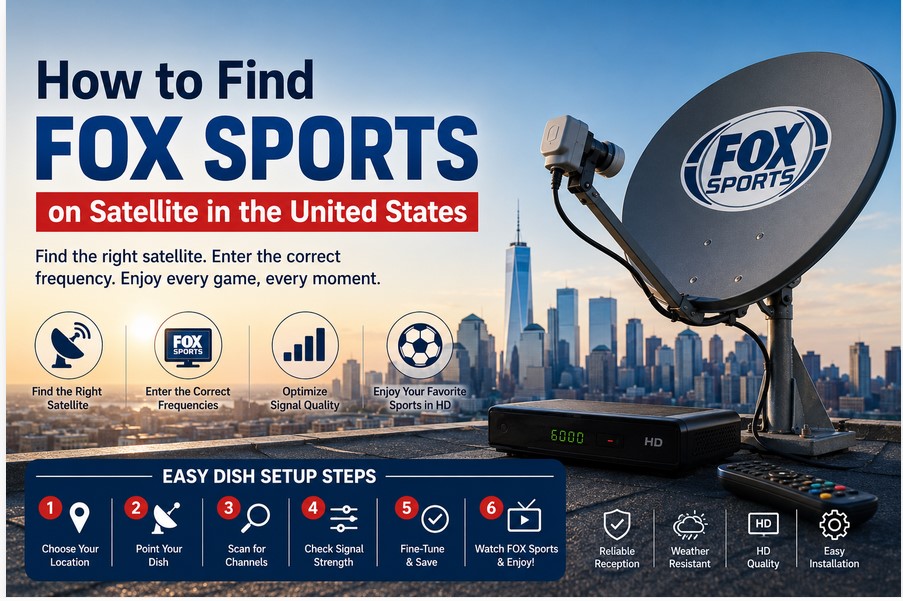
How to Point Your Satellite Dish at FOX Sports
Accurate alignment is location-specific and must match the orbital position of the chosen satellite.
- Determine your exact location using city, ZIP code, latitude, and longitude.
- Identify the correct satellite and confirm its orbital position before moving the dish.
- Calculate the azimuth (horizontal compass direction).
- Calculate the elevation (vertical angle above the horizon).
- Set the LNB skew or polarization angle when required.
- Install the dish mast so it is perfectly vertical.
- Check the line of sight and remove any trees, buildings, walls, or other obstacles.
- Begin the satellite search by moving the dish slowly and carefully.
- Monitor signal quality on the receiver, which is more useful than signal strength alone.
- Fine-tune the dish with small adjustments to achieve the strongest stable signal.
- Secure the dish by tightening the mounting hardware without changing the alignment.
- Perform a final scan of the relevant transponder or satellite and verify the channels.
Exact azimuth and elevation values change with geographic location. Professional tools or software generate precise figures for any ZIP code or coordinates.
How to Enter FOX Sports Frequencies Into a Satellite Receiver
Manual entry of verified parameters allows a compatible receiver to locate the desired transponder.
- Open the satellite installation or setup menu.
- Select or add the correct satellite name and orbital position.
- Choose the manual or single-transponder scan option.
- Enter the verified frequency.
- Select the correct polarization.
- Enter the symbol rate.
- Enter the FEC value if the menu requires it.
- Select the appropriate DVB system or modulation when supported.
- Start the scan.
- Check the resulting signal strength and quality readings.
- Save the detected channels.
- Verify whether the channel requires subscription authorization.
Menu names vary by manufacturer and model. Consult the receiver manual for exact navigation steps.
How to Get the Best FOX Sports Signal Quality
Once an initial signal is found, further optimization improves reliability.
- Fine-tune azimuth in very small increments.
- Fine-tune elevation carefully while watching the quality meter.
- Adjust LNB skew if polarization is not already optimal.
- Check that the dish mount remains rigid and vibration-free.
- Inspect the coaxial cable for damage or excessive length.
- Examine all connectors for corrosion or poor contact.
- Remove moisture exposure and protect outdoor fittings.
- Confirm the line of sight remains completely clear.
- Monitor signal quality over several minutes for stability.
- Test performance under different weather conditions to verify adequate margin.
Common FOX Sports Satellite Reception Problems
Reception issues usually fall into recognizable categories that can be diagnosed systematically.
Wrong Satellite
A strong signal from an incorrect orbital position yields either no channels or channels belonging to a different service. Confirm the provider’s current satellite list before realigning.
Outdated Frequency
Old or mistyped frequency, polarization, or symbol-rate values prevent the receiver from locking the transponder. Always use the latest verified parameters.
Weak Signal
Incorrect alignment, partial obstructions, damaged LNB, poor cable connections, dish movement, weather attenuation, or insufficient dish size all reduce signal quality. Correcting the physical installation usually restores performance.
FOX Sports Channel Found but Not Available
Encryption, missing authorization, regionally restricted rights, or incompatible receiver software commonly cause this symptom even when the signal meter shows lock. Verify the subscription status with the provider.
Some FOX Sports Channels Work and Others Do Not
Different channels may occupy separate satellites, transponders, or beams, or may require different authorization packages. The presence of one channel does not guarantee the presence of another.
Weather and FOX Sports Satellite Reception
Heavy rain, thunderstorms, snow, ice, and strong winds can temporarily degrade or interrupt satellite signals. Rain fade occurs when atmospheric moisture attenuates the microwave path. A dish aligned with only minimal quality margin loses lock more readily than one optimized for high quality. After severe weather, inspect the dish for ice, snow, or mechanical displacement and recheck signal quality once conditions clear.
How to Improve FOX Sports Satellite Reception
- Use current frequency parameters obtained from reliable sources.
- Apply location-specific azimuth, elevation, and skew values.
- Keep the dish mount stable against wind movement.
- Maintain a completely clear line of sight.
- Inspect the LNB for damage or water intrusion.
- Examine coaxial cables for cuts, kinks, or corrosion.
- Replace damaged or poorly installed connectors.
- Protect all outdoor connections from moisture.
- Fine-tune the dish after the initial installation.
- Recheck alignment after severe weather.
- Confirm the receiver is fully compatible with the required system and encryption.
- Contact a professional installer when consistent high-quality reception cannot be achieved independently.
Frequently Asked Questions
Viewers share many of the same questions about locating FOX Sports on satellite. The answers below address the most common concerns with practical, accurate information.
What satellite carries FOX Sports in the United States?
FOX Sports services are distributed across multiple satellites operated by different providers. DISH Network commonly uses EchoStar and Nimiq positions, while DirecTV uses its proprietary fleet. Distribution feeds also appear on C-band satellites such as Galaxy 32. The applicable satellite depends entirely on the authorized service and channel.
What is the current FOX Sports satellite frequency?
There is no single universal FOX Sports frequency. The correct parameters depend on the channel, satellite, provider, and current transponder assignment. Refer to the verified frequency section of this article and confirm any values before use, because parameters can change.
What is the FS1 satellite frequency?
FS1 appears on several satellites and providers. Exact parameters vary and must be matched to the specific service. Current verified examples appear in the FS1 frequency section above.
What is the FS2 satellite frequency?
FS2 is distributed independently of FS1 on multiple platforms. Always verify the latest parameters for the authorized service rather than assuming they match FS1.
Can I receive FOX Sports with a standard satellite dish?
A standard residential dish and receiver can receive FOX Sports when the programming is part of an authorized consumer subscription package from a compatible provider. Professional or certain distribution feeds require specialized equipment and authorization.
Is FOX Sports free-to-air by satellite?
Most FOX Sports transmissions serving U.S. residential viewers are encrypted and require an active subscription. Free-to-air residential FOX Sports feeds are not the normal distribution method for domestic audiences.
How do I point my dish at FOX Sports?
Determine the correct orbital position for the authorized service, calculate location-specific azimuth and elevation, set LNB skew if required, ensure a clear line of sight, and fine-tune while monitoring the receiver’s signal-quality meter until a stable lock is achieved.
Why can’t my receiver find FOX Sports?
Common causes include selection of the wrong satellite, outdated frequency parameters, insufficient signal quality, incompatible receiver hardware or software, and lack of subscription authorization.
Why does my FOX Sports signal disappear during heavy rain?
Rain fade attenuates the signal. A dish with limited quality margin is more susceptible. Improving alignment and ensuring adequate signal margin reduces the frequency of weather-related outages.
Can trees block a FOX Sports satellite signal?
Yes. Trees and dense foliage can obstruct the microwave path between the dish and satellite, causing signal loss or complete blockage. Seasonal leaf growth may introduce problems that were not present during installation.
Can I use the same FOX Sports frequency in every US state?
The frequency parameters remain associated with a specific satellite transmission, but reception success depends on whether the beam covers the location, whether the dish is correctly aligned for that location, and whether the receiver is authorized.
How can I improve my FOX Sports satellite signal?
Use precise location-specific alignment, maintain a clear line of sight, secure the mount, inspect cables and connectors, weatherproof outdoor fittings, and optimize for signal quality rather than strength alone. Professional installation is advisable when consistent high-quality reception cannot be achieved independently.